
SAS is an international organisation dedicated to researching, developing and providing effective neuro-sensory intervention techniques that strengthen sensory processing, language, memory and understanding and that enhance physical abilities, speech, reading and writing and that improve behaviour, social skills and emotional well-being.
Our methodology is firmly based on scientifically proven principles and we gather data on the effectiveness of our courses through six distinct routes:
- Pre and post course assessment test results;
- Observations by trained staff during the assessment and course delivery stages;
- Anecdotal feedback by clients, parents, caretakers or teachers, both during and post courses;
- Standardised post-course feedback forms from clients;
- Independent feedback from educational and medical establishments involved in SAS research projects;
- Independent research by recognised academic establishments such as Teaching Hospitals and Universities.
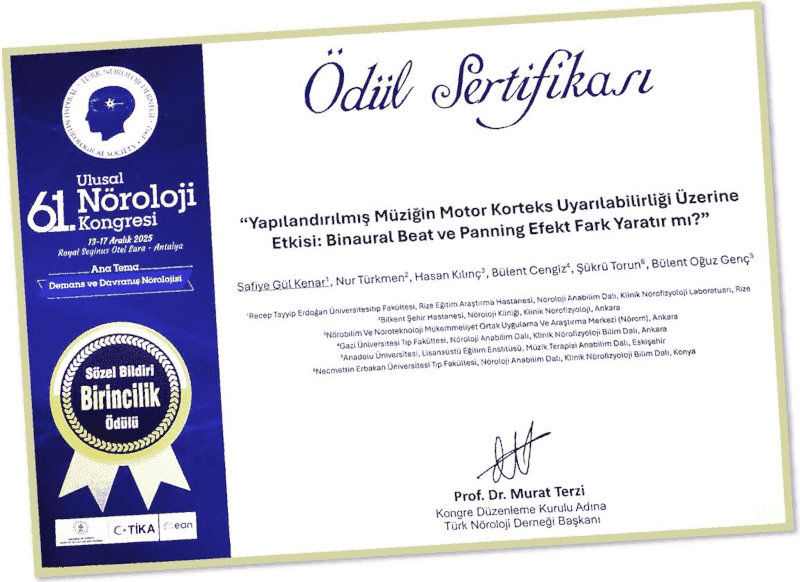
The 61st National Neurology Congress, held from 13 to 17 December 2025 in Antalya Turkey, attracted nearly two thousand participants.
At this congress we were awarded "FIRST PLACE" for our research titled "The Effect of Structured Music (SAS Method) on Motor Cortex Excitability", which was conducted at Neurom Ankara, under the leadership of our Scientific Advisor Prof. Dr. Şükrü Torun.
This award is a source of great pride to the SAS Organisation and motivates us to continue to develop the SAS Method based on proven scientific evidence.
Quick Links:
- Client Statistics
- Client Feedback
- Research - Nocturnal Enuresis (Bed Wetting) - University, İstanbul, Türkiye
- Research - ADHD - Centre, Berlin, Germany / University, Eskisehir, Türkiye
- Research - ADHD - University, İstanbul, Türkiye
- Case Report - Autism - Centre, Berlin, Germany / University, Eskisehir, Türkiye
- Research - Autism - Universities, Türkiye
- Research - Cornelia de Lange Syndrome - University, İstanbul, Türkiye
- Research - Cerebral Palsy - Universities, Türkiye
- Research - Reading and Writing - University, Izmir, Türkiye
- Research - Emotional Well-Being (1) - University, The Netherlands
- Research - Emotional Well-Being (2) - University, The Netherlands
- Research - Autism - University, Ankara, Türkiye
- Research - Auditory Processing - University, Ankara, Türkiye
- Research - Learning Enhancement - Primary School, U.K.
- Research - Autism/ADHD - Special Needs Secondary School, U.K.
SAS | Client Statistics | 2025
Condition Categories - Calendar Year 2025
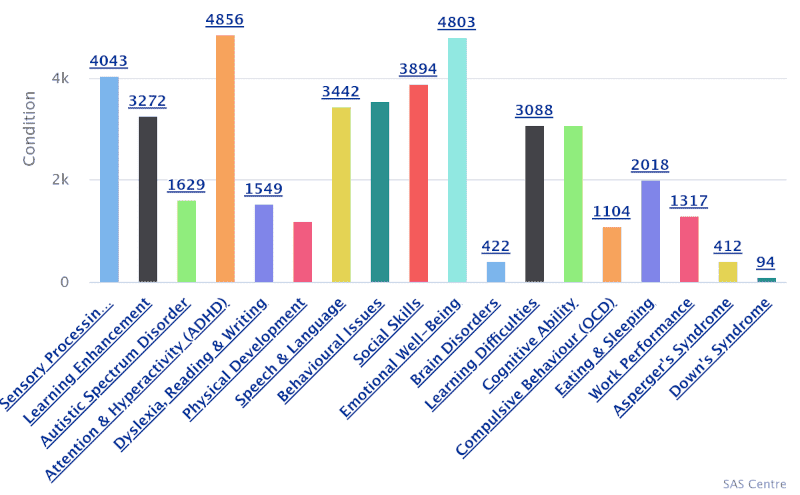
Age Groups (All Clients - Calendar Year 2025):
0 - 5 yrs: 19.9 %
6 - 11 yrs: 49.5 %
12 - 17 yrs: 13.1 %
18+ Yrs: 17.5 %
SAS | Client Feedback
All Conditions:

Learning Enhancement:

Male: 60.0 % - Female: 40.0 %
Age 0 to 6: 10.3 % - Age 7 to 11: 55.2 % - Age 12 to 17: 24.8 % - Age 18+: 9.7 %
Emotional Well-Being & Social Skills:

Male: 54.0 % - Female: 46.0 %
Age 0 to 6: 19.5 % - Age 7 to 11: 37.9 % - Age 12 to 17: 24.1 % - Age 18+: 18.4 %
Attention Deficit - Hyperactivity - ADHD:

Male: 69.5 % - Female: 30.5 %
Age 0 to 6: 7.4 % - Age 7 to 11: 54.1 % - Age 12 to 17: 30.3 % - Age 18+: 8.2 %
Reading - Writing - Dyslexia:

Male: 59.3 % - Female: 40.7 %
Age 0 to 6: 11.3 % - Age 7 to 11: 54.0 % - Age 12 to 17: 27.3 % - Age 18+: 7.3 %
Speech & Language:

Male: 69.2 % - Female: 30.8 %
Age 0 to 6: 29.9 % - Age 7 to 11: 43.6 % - Age 12 to 17: 17.9 % - Age 18+: 8.5 %
Autistic Spectrum Disorder - Developmental Delay:

Male: 71.2 % - Female: 28.8 %
Age 0 to 6: 30.9 % - Age 7 to 11: 41.0 % - Age 12 to 17: 23.0 % - Age 18+: 5.0 %
The Effectiveness of Music-Based Sensory Activation Solutions (SAS) Method in Patients with Treatment-Resistant Nocturnal Enuresis | 2025
Sevim Yener M.D. 1, Soner Ozaner 2, Neriman Terzi 3
1- Health Sciences University Umraniye Training and Research Hospital, Department of Pediatric Urology, İstanbul, Türkiye.
2- Health Sciences University Umraniye Training and Research Hospital, Department of Child and Adolescent Psychiatry, İstanbul, Türkiye.
3- Health Sciences University Umraniye Training and Research Hospital, Department Clinical Psychology, İstanbul, Türkiye.
Abstract
Objective: Although nocturnal enuresis is a somatically benign condition, it can pose long-term psychosocial risks if left untreated. Treatment efforts continue, particularly for treatment-resistant nocturnal enuresis. We aimed to evaluate the effectiveness of music-based sensory activation solutions (SAS) in treating enuresis in patients who have not responded to treatment options listed in guidelines.
Patients and Methods: In this prospective study, patients aged 6-17 years who were referred from departments other than the child psychiatry outpatient clinic with complaints of nocturnal enuresis were included. Patients were divided into two groups: a study group and a control group. Patients who received treatment for at least 6 months and did not respond were included. The Sensory Activation Solutions (SAS) method aims to synchronize brain waves and promote neuroplasticity by using specific frequency, rhythm, and melodic features of music. The monthly dry duration of the patients before the start of the SAS method was recorded, and the monthly dry duration was recordedagain during the program and 1 month after the end of the program with a follow-up examination. The SAS method was planned to last for 3 weeks (21 days). An audio program was applied with over-ear wireless headphones.
Results: There were 28 patients in both groups. It was found that there was no significant difference between the study patients and the control group in terms of age and gender group distributions (χ2(10) = 9.67, p = .470), (χ2(1) = 0.35, p = .554). In the comparison made between the period before the SAS application and 1 month after the application, a significant decrease was found in the frequency of bedwetting in children (Z = −4.41, p < .001).
Conclusion: Multidisciplinary and individualized approaches are essential in cases of treatment-resistant nocturnal enuresis. SAS method may be a non-invasive, safe, and effective treatment option for cases of resistant enuresis. There is a need for large series investigating the long-term outcomes of treatment protocols that address physiological, behavioral, and psychosocial components together, supported by innovative neuromodulation methods, such as SAS.
The Supportive Effect of Non-Invasive Structured Music-Based Auditory Stimulation (SAS) on the Treatment of Children with ADHD | 2024
Clinical Psychologist Banu Dereyurt 1, Prof. Dr. Şükrü Torun 2
1- Banu Dereyurt Counseling Center, Berlin, Germany.
2- Anadolu University, Graduate School, Department of Music Therapy, Eskisehir, Türkiye.
Abstract
This study aimed to examine the effectiveness of the SAS program in individuals diagnosed with ADHD. The research was conducted using an experimental method. A pre-test/post-test control group design was used in the study. Individuals diagnosed with ADHD were divided into experimental and control groups. A total of 40 children participated in the study, 35 boys and 5 girls. 20 of the 40 participants formed the experimental group and 20 formed the control group. All participants in the experimental group participated in the SAS program application. In addition, 15 of the participants in the experimental group received cognitive behavioural therapy, and 5 received a structured attention program. 18 of the participants in the control group received Cognitive Behavioural Therapy (CBT), and 2 received an attention training program. All participants completed the Sociodemographic Information Form. SPSS 26.0 program was used to compare the attention deficit and hyperactivity scores of the groups in the study. The study found no significant difference between the pre-test Moxo scores of the participants in the experimental and control groups. However, a significant difference was found between the pre- and post-test levels of the hyperactivity and timing subscales of the Moxo in the participants in the experimental group. According to the study findings, it was determined that the level of ADHD symptoms in the post-test measurements was partially reduced in the individuals in the experimental group when compared with the pre-test results. At the same time, when the pre-test and post-test scores of the individuals in the experimental group were compared, it was found that the SAS method accelerated the ADHD treatment of the child. In conclusion, it can be said that the SAS program is a method that contributes to the reduction of attention deficit and hyperactivity symptoms. In this context, it can be stated that the application of SAS has positive effects in the ADHD treatment process.
Investigation of the Effects of the SAS Auditory Stimulation Method on Attention, Hyperactivity, and Impulsivity in Children Aged 8-12 | 2024
Nisa Metin 1
1- Üsküdar University, Institute of Health Sciences, Department of Neuroscience, İstanbul, Türkiye.
Abstract
In this study, the effects of the SAS Auditory Stimulation Method on children with ADHD (Attention Deficit Hyperactivity Disorder) were examined. At the first stage, a MOXO (d-CPT) test was conducted to 10 students, aged between of 8 to 12 years of age, to determine their attention, timing, hyperactivity and impulsivity levels. Additionally, evaluation and information forms were completed by the parents. A special auditory program was prepared for each student and they listened to the program, which includes frequencies, sound transitions, rhythm, tones and speech sounds, for 24 days, 40 minutes each day. After finishing the auditory program, the same MOXO (d-CPT) test were conducted again and improvements in students’ attention, hyperactivity and impulsivity levels were observed.
Music Therapy Facilitated by Music-Based Sensory Activation in Autism: A Case Report | 2024
Duygu Duran-Firat 1, Sukru Torun 2, 3
1- Kinder- und Jugendambulanz / Sozialpädiatrisches Zentrum, Berlin, Germany.
2- Anadolu University, Eskisehir, Türkiye.
3- Uskudar University, Istanbul, Türkiye.
Abstract
Children with autism spectrum disorder (ASD) have problems with communication, behaviour, and social interaction, and many respond abnormally to sounds. We report case, a nine-year- old girl (nickname Eylul) with ASD showing high sensitivity to sounds, poor emotional control and self-harming behavior. She referred to the Social Paediatrics Center Child and Youth Polyclinic for music therapy. We made a music therapy plan, but even the ordinary sounds of the instruments were too stimulating for her, so she covered her ears and shouted during the first session. She just sat and not moved. She did not accept the game offered by therapist. To reduce auditory hypersensitivity and support cognitive and psychosocial skills, we decided to try SAS (The Sensory Activation System), an individually structured music-based auditory stimulation program, with the permission of Eylül's parents and psychiatrist. While music therapy continued, September started listening to SAS programs at home (the first 24 days-40 min/day, two-months break, and plus 24 days-60 min/day). From the second week, Eylul's compliance with MT sessions increased significantly. She began to use new areas where she could move freely during the session. During 44-session active MT process carried out with the support of SAS, she has gradually made significant progress in communication and anger control. Now she can go to the cafe with her mother, doing shopping, participating in games/dancing. We suggest that SNS can be tried as a supportive application, especially in interventions for autistic people who show auditory hypersensitivity and have adaptation problems.
The Effect of a Music-Based Sensory Activation System (SAS) on Self-Perception, Self-Efficacy, and Self-Control Skills in Children with Autism | 2024
Paper presented at the International IAMM Conference, Berlin, September 2024, by Şükrü Torun 1,2 , Gamze Sertbaş 3
1- Anadolu University, Graduate School, Department of Music Therapy, Eskisehir, Türkiye.
2- Uskudar University, Graduate School of Health Sciences, Department of Speech and Language Therapy, Istanbul, Türkiye.
3- Private Gönen Development, Special Education and Rehabilitation Center, Balikesir, Türkiye.
Abstract
The Neuro-Sensory Activation System (SAS), a non-invasive structured music-based auditory stimulation method, has been used safely for many years to support sensorimotor, cognitive, emotional and behavioral skills in neurodevelopmental disorders. However, the literature regarding its effects on various neurodevelopmental problems is still limited. In this study, we evaluated the effect of SAS listening programs applied in 30-minute sessions a day for 21 days in 8 children with Autism Spectrum Disorder (ASD) of 3-5 years old having low self- perception, self-control, self-efficacy skills. In the post-application assessment, significant improvements were observed in the parameters related to self-perception, self-efficacy and self-control skills in all children compared to the pre-application period.
SAS Music Listening Program Application on the Cognitive Level in a Child with Cornelia de Lange Syndrome | 2024
Journal of Natural Life Medicine / 2024 | Volume: 6 Issue: 2, Doi: 10.71051/jnlm.1573934, Onur Birol KIRIŞ 1, Evren ERİK 2
1- Üsküdar Üniversitesi Sağlık Bilimleri Enstitüsü, M.A. (Müzik), Ph. D. Öğr. (Nörobilim), İstanbul, Türkiye.
2- SenseCosmos FTR Danışmanlık, Uzman Fizyoterapist, İstanbul, Türkiye.
Abstract
Cornelia de Lange Syndrome (CdLS) is a rare genetic disorder characterized by cognitive and physical developmental delays. Sensory Activation Solutions (SAS) is a music and sound-based neural activation system designed to strengthen neural networks in the brain and enhance cognitive processes. This study was conducted using a single-subject research design within the framework of a quasi-experimental design. It examined the participation of a three-year-old child diagnosed with CdLS in the SAS music listening program, which comprised three cycles, each lasting 21 days, with daily sessions of 30 minutes. Post- intervention assessments indicated a 10-15% improvement in the child’s cognitive abilities. These findings may suggest that music-based neuromodulation holds therapeutic potential for complex conditions such as CdLS.
The Effect of Music-Based Sensory Activation Solutions (SAS) Method on Cognitive Problems in Children with Cerebral Palsy | 2024
Şükrü Torun 1 Merve Can 2
1- Üsküdar University Institute of Health Sciences, Türkiye.
2- Antalya Anka Child Development Center, Türkiye.
Abstract
Although most research has focused on aspects related to motor function, studies addressing the cognitive problems that frequently accompany Cerebral Palsy (CP) have been increasing in recent years, and the need for more holistic treatment approaches that also include these problems is being emphasized. The aim of this study is to draw attention to the cognitive, linguistic, and behavioral disorders that should not be neglected in the management of CP and to examine the effect of the SAS (Sensory Activation Solutions) method, a structured music-based auditory neuroactivation program, on these disorders. In our study, 33 children (20 boys, 13 girls) aged 2-8 years who were diagnosed with CP and also experienced various cognitive problems were given individualized 20, 30, or 60-minute SAS listening programs via over-ear headphones for 14, 21, 24, or 28 days. No restrictions or additional instructions were applied to the children during the listening sessions. The effects of the SAS method were evaluated using the pre-test-post-test method, and comparative analyses of the data were performed using IBM SPSS Statistics 27.0. Our results suggest that the SAS Method is effective in reducing cognitive problems accompanying motor impairments in SP and can be used as a supportive application to mainstream treatment processes.
The Effect of the SAS Method on Eliminating Reading and Writing Difficulties | 2023
A master thesis by Zeynep Aydin, accepted by the Dokuz Eylül Üniversite, Türkiye.

The research involved 12 students in Year 3 (8 years of age) in two primary schools, all identified as having difficulties with reading and writing. Six were allocated to the control group and six to the SAS Course group.
Results: The group following the SAS course showed a statistically significant improvement compared with the control group and achieved above-standard results in the post course test.
SAS | Emotional Well-Being (1) | Radboud University, The Netherlands | 2015
Researching the effects of a single 24 day SAS course, using E.E.G. measurements. Subject: 77 year old female. Condition: not able to cope in daily life, emotional and sensory overload, stress, anxiety, loss of confidence.
E.E.G. measurements before taking the SAS Course:


E.E.G. measurements after taking the SAS Course:


SAS | Emotional Well-Being (2) | Radboud University, The Netherlands | 2015
Researching the effects of a single 24 day SAS course, using Normed CNSVS tests. Subjects: 47 year old female with depression and a 51 year old female with depression and recovering from burn-out.
47 year old female, normed CNSVS test before taking the SAS Course:

47 year old female, normed CNSVS test after taking the SAS Course:

51 year old female, normed CNSVS test before taking the SAS Course:

51 year old female, normed CNSVS test after taking the SAS Course:

SAS | Autism | University, Ankara, Turkey | November - December 2012
As part of an ongoing collaboration with a University in Ankara, Turkey, a pilot reseach programme was initiated at their Occupational Therapy Department.
Led by the head of the department the study comprised of two randomly selected groups of children diagnosed with Autistic Spectrum Disorder, aged 4 to 15 years. One group received only Sensory Integration Therapy, while the second group received Sensory Integration Therapy plus a SAS Neuro-Sensory Programme - in total 22 children completed the whole programme. The SAS Neuro-Sensory Programme was provided for one hour each day, five days a week over four weeks, 20 hours in total.
Results: Feedback indicates a significant decrease in anxiety levels and a reduction in visual, auditory and tactile sensitivities for the second group receiving the SAS Neuro-Sensory Programme, compared with the first group that received Sensory Integration Therapy only.
SAS | Auditory Processing | Ufuk University, Ankara, Turkey | May 2012
A research project was conducted at the Ear Nose and Throat Department at Ufuk University Hospital under the auspices of Dr. Rıdvan Ege and Prof. Dr. Sinan Kocatürk and his team Doç. Dr. Kaan Beriat and audiologist Figen Bağcı.
The project started with a group of 10 randomly selected patients, all with significant word discrimination problems, not considered to be caused by the hearing loss they all suffered from. Due the the advanced age of some of the patients, only three were able to complete the full programme.
Age and Gender Distribution: The mean age was 50, two male and one female.
General Condition: All three patients suffered from mild to severe hearing loss, however this was not considered to be the primary cause of their significant word discrimination problems by the ENT Specialists at the hospital.
Implementation: At the hospital the patients listened for one hour each day to a SAS Neuro-Sensory Programme, 18 hours in total over a three week period. During their listening sessions the patients were allowed to read books, newspapers or magazines.
Objective: To establish if improvements in Word Discrimination ability can be achieved through the application of a SAS Neuro-Sensory programme.
Assessments: Pre- and post-programme Word Discrimination tests were applied under the supervision of Dr. Rıdvan Ege of the Ear, Nose and Throat Department at Ufuk University Hospital.
Results: The pre- and post-programme test results are provided in the table below.

| Sample | Pre-Programme | Post-Programme |
|---|---|---|
| Patient 1: M.C. |
Right Ear 88 % Left Ear 90 % |
Right Ear 90 % Left Ear 90 % |
| Patient 2: H.G. |
Right Ear 88 % Left Ear 94 % |
Right Ear 94 % Left Ear 100 % |
| Patient 3: M.O. |
Right Ear 72 % Left Ear 68 % |
Right Ear 94 % Left Ear 100 % |
Note: Results of a word discrimination test conducted under controlled conditions at Ufuk University Hospital by audiologist Figen Bağcı.
SAS | Learning Enhancement | Primary School, U.K. | June - December 2012
The school is a voluntary controlled CofE Primary School with around 200 pupils. A pilot programme with four pupils aged 7 to 9 was completed during the Summer 2012 term. Following positive feedback from the children, parents and teachers it was decided to make this a continuous research project with six children taking the programme at any one time.
A special SAS Schools programme was developed to allow for sessions of 40 minutes in duration. The pupils follow the programme 5 days a week, Monday to Friday, over a 5 week period. The 25 sessions equate to just under 17 hours of listening time in total. The programmes employ the same techniques as used by SAS Centres and Practitioners and include music, language and tones. All pupils receive the same generalised programme.
All sessions are administered by an SAS trained Teaching Assistant, who receives weekly supervision by an experienced SAS Accredited Practitioner. The school carefully monitors progress, records academic and personal skills attainment and collates child, teacher and parent feedback.
Results: Initially only children requiring extra help with reading or writing, or with sensory processing, were chosen to participate. Given the substantial improvements these children made. it was decided to invite children without observed difficulties into the program. The children in this second cohort made faster progress in their learning than other children of the same age and abilities.
SAS | Autism/ADHD | Special Needs Secondary School, U.K. | 2010 - 2012
The school is a Special Needs Secondary School with about 150 students with moderate learning difficulties, 11 to 19 years of age. A research project with 16 students was instigated during the Summer term of 2010. Eight students with either AD/HD or autism received the programme, while a balanced control group of eight other students were tested pre- and post-programme, but were at this stage not offered the listening time.
The students received standard SAS programmes of 60 minutes in duration. The students followed the programme 5 days a week, Monday to Friday for 16 hours in total. The programmes employed the same techniques as used by SAS Centres and Practitioners and included music, language and tones. All students received the same generalised programme.
All sessions were administered by an SAS trained Teaching Assistant. The school carefully monitored progress, recorded academic and personal skills attainment pre- and post-programme and collated child, teacher and parent feedback.
Results: The positive improvements in academic achievement, behaviour and emotional well-being of the listening group compared to the control group were such that the school decided to offer the programmes on a continuous basis to selected students, starting with the control group.
